


Sweet Skies is the incredible story of children finding their way in war-torn Berlin. It’s 1948. Otto is fascinated by the American pilots who fly in and out of this city under seige when Russia has blocked off every road, railway and waterway into the western zone. The Luftbrücke – an airbridge to keep Berlin alive – changes their lives bringing new perspective, hope for the future and chocolate.
This story is full of innocence and courage. Otto and his friends discover that perhaps the American heroes aren’t all they seem to be while forcing themselves to stand up to the Russians who seek to terrorise and control them. There are dangerous games to be played as dreams are chased and changed.
Otto’s relationship with his father is so thought-provoking. A prisoner of war returning home after seven years away, he doesn’t understand Otto and his mother’s relationships with people who were once enemies. The Nazis have lost – now what does that mean for their family and future?
Sweet Skies reveals a time period not often shared in children’s books. The German point of view challenges readers’ views of the war and encourages them to recognise the struggle of ordinary people who were influenced or terrorised by their government. Otto is a hero who stands up for himself, his friends and his family.
I’m honoured to welcome author Robin Scott-Elliot to my blog with a guest post describing the struggle of Berlin.

Berlin, the city that rose from the ashes
guest blog post by Robin Scott-Elliot
“Once you had Berlin, you had the world. And once you lost Berlin, you lost the world.”
Sweet Skies is played out among the ruins of post-war Berlin. Otto, Ilse and Karl scrabble to rebuild their lives while around them the city itself is being painfully put back together.
Berlin is a European capital like no other. None has shown so many different faces to the world as Germany’s.
In the last century alone, it’s had the dazzle of the Anything Goes 1920s; the depths of the Depression; the darkness of the Nazis; the destruction brought by the regime’s downfall; the lonely chill of the Cold War; the pain of the Wall going up; the joy of the Wall coming down and now it’s a city open to all once more, a city at the heart of Europe.
It’s modern history alone is seismic. Let’s begin in 1918. By the end of the First World War the city was close to collapse – children were dying at the same rate as Medieval times. There was violence in the streets, from robbery to revolution. Inflation was rampant, some carried money in wheelbarrows – because 4.2 billion marks were needed to get one dollar.
But such trauma and chaos brought change. Old restrictions were cast-off and in the Weimar years it blossomed into an anything-goes city, the city of Cabaret. It has always seemed a city of contradictions. Sexual freedoms unknown across most of the rest of the world in the capital of Prussia and militarism, a city where the Communists attracted significant support, a city where the idea of Das Volk first found its feet.
But darkness was coming. Berlin never took to the Nazis as the rest of its country did. In the last non-rigged election in 1932, the Communists were still attracting more support. Yet the Nazis had arrived in Berlin and in power.
The attacks on Jews began immediately, and so did attacks on freedom of speech. In May 1933 came the first book burnings, in a grand scale in Operaplatz; Einstein, Mann, Brecht, Hemingway went up in flames, even Erich Kastner, author of the children’s favourite Emile and the Detectives.
There was more deadly fire in 1938, Kristallnacht; Jewish shops, synagogues and businesses burnt to the ground. “The devil is walking Berlin,” said one persecuted Jew. Those that could fled, among them Judith Kerr, without her pink rabbit.
Hitler never liked Berlin, its architecture or its people. His masterplan was to demolish it and replace it with Germania. Berlin was destroyed, but not according to Hitler’s plan. By the time the British and US bombers and the Soviet army were finished there was not much left.
By the end of the war and the division of the city into four sectors, American, Soviet, British and French, the pre-war population of four million was halved, two-thirds of those left women. In central districts such as Mitte, Charlottenburg and Tiergarten, there was hardly a building left standing. Incredibly, 8,000 Berlin Jews emerged from hiding, although that left some 60,000 gone forever.
Life was grim. There was little to eat, dead horses were butchered in the street – the few remaining animals in Berlin zoo had to be guarded round the clock. Corpses rotted in the ruins, disease spread, 50,000 homeless orphans struggled to survive, looting was rife, as was the black market where watches were more valuable than gold. Soviet soldiers wore four or five up each arm.
This is the world in which Otto, Ilse and Karl, already damaged by war, find themselves in Sweet Skies.
In 1948 came the Soviet blockade, the outcome of rising tension between east and west. On 24 June, the Russians closed off all rail, road and waterborne routes into West Berlin. Gas and electricity supplies were cut as well as food. This was a medieval act – West Berlin was under siege. The Cold War had begun in earnest.
It lasted a year, but the western allies would not back down. At its peak, US and British aircrews were landing a plane every minute.
The Americans would not give in to the Russians and neither would the West Berliners. Ernst Reuter, the mayor of Berlin, a former Communist who’d known Lenin, made a speech in front of the ruined Reichstag as American planes flew overhead.
“People of this world, look upon this city and see that you should not, cannot abandon the city and this people.”
Berlin’s image had transformed from the “lair of the Fascist beast” to the front line of democracy. Men who dropped bombs on the city now dropped sweets to the delight of the real Ottos.
The consequence for the people of East Berlin was less sweet. The success of the Luftbrucke cemented the division of Germany.
West Berlin began a new act in its turbulent existence. It may have been an island of West Germany, but it was not alone. The airlift was the start of a dedicated relationship between the city and the US. To the US, Berlin was a shining outpost in the fight against Communism.
In 1963, John F Kennedy came to Berlin, and spoke to an audience of 120,000 Berliners.
“Two thousand years ago, the proudest boast was civis romanus sum – I am a Roman citizen. Today, in the world of freedom, the proudest boast is ‘Ich bin ein Berliner!’ All free men, wherever they may live, are citizens of Berlin, and therefore as a free man I take pride in the words ‘Ich bin ein Berliner’.”
I like to imagine standing somewhere in that crowd were the grown-up Otto, Ilse and Karl, Berliners and proud to be Berliners.
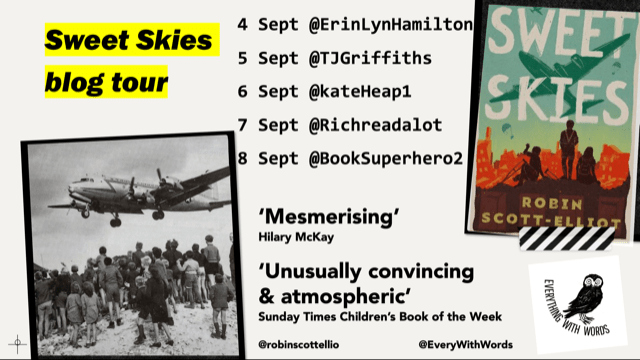
Don’t miss the rest of the blog tour with more fascinating insight into this important point in history.
Follow these links to find out more or purchase on-line:
Bookshop.org:

Amazon:


Books by Kate Heap:
New!!
Order Fiction & Poetry and Non-fiction for Year Two on the links below:


Books for Years 3 -6:


 Scope for Imagination
1 thought on “Sweet Skies by Robin Scott-Elliot ~ Blog Tour”