



No time for simpering or smelling salts – there’s a scoundral to catch.
Her Majesty’s League of Remarkable Young Ladies is delightful right from the start. With an Enola Holmes feel of clever young women who refuse to conform to society’s expectations, readers will quickly become great friends with 14 year-old Winnifred as she takes on the world. We first meet Winnie disguised as a boy trying to convince the British World Fair Selection Committee that the invention she’s been working on with her father is a worthy entry for the 1889 World Fair in Paris. Her technological genius is unheard of in girls but she’d much rather pursue her engineering dreams than settle down with a boring home or demanding husband.
Her reputations grows and Winnie finds herself with the offer of a lifetime – to be part of a top secret group of female spies who are responsible for the future wealth and stability of the nation as well as the personal safety of Queen Victoria. Winnie will be designing and building tools of espionage for female agents.
She and the other girls encounter one adventure after another as they strive to stop the dangerous Mr Magpie who threatens the Queen. All the while, Winnie is trying to find a way to save her father and get to the World Fair in time.
This is a brilliant STEM-fuelled Victorian mystery for readers age 11+.

How Did a NON-STEM Writer Come to Write a STEM Story?
Guest Post by Alison D Stegert,
Author of Her Majesty’s League of Remarkable Young Ladies

I’m a writer. Letters, words, and punctuation are my tools. When confronted with numbers, I see flashes of white, and I sweat, an unfortunate conditioned response leftover from my childhood tussles with mathematics. So how did I end up writing a kids’ story packed with elements of STEM (Science, Technology, Engineering, and Maths)?
As a kid, I was a self-amuser – dreamy, quirky, and always busy. Give me a wooden wine crate and I’d turn it into a fully furnished townhouse for a pair of toy mice. Kitchen sponges became messy science experiments. Blanket forts? Mine were sprawling citadels equipped with periscopes, tunnels, and secret escape hatches. I designed twisty waterslides for unfortunate Barbie dolls. I rehomed spotted orange newts (poor creatures) in mossy habitats luxuriously appointed with ashtray swimming pools. I dammed streams to “help the tadpoles” and to “encourage beavers.” (There were no beavers.)

While my mother was proud of my ability to amuse myself for hours on end, she was also exhausted by the scale of my messes and the level of nagging required to coax me to tidy up. Seeking more manageable alternatives, she suggested I try reading and thrust books in my hands – Pippi Longstocking, Harriet the Spy, Ramona the Pest and more. ‘They’re fun!’ she promised. Books? Fun? Sure…
Unexpectedly, I discovered characters just like me – barefooted girls with leaves tangled in their hair and dirt under their nails: tinkerers, explorers, and mess-makers. The moment Pippi Longstocking strapped scrub-brushes to her feet to make floor washing quicker and more amusing, I knew I‘d found a soulmate. Harriet and Ramona inspired me with their daring sassiness, but the character who sparked me most was Mary Lennox in The Secret Garden. I delighted in the possibility – the audacity – of transforming someone else’s bramble patch into a secret playground. Far from tempering my “messy streak,” these stories reinforced it.

As a kid, I knew on a subconscious level I didn’t fit the mould of sweet, neat, frilly girls. My knees were scabbed, and my sneakers were caked with mud. My slouching earned constant adult disapproval. But Pippi, Mary, and other quirky, resourceful girl characters inspired in me a new sense of acceptability, of belonging. Books affirmed me.
Winifred Weatherby, my girl-genius protagonist, was probably an inevitable character for me to create. When Winnie appeared on my page, full of sass and smarts, I knew immediately she was special and deserving a proper adventure. I filled her with unconventional interests and big dreams; I set her up in a world that was not ready to welcome a girl with engineering aspirations; and I let her loose to make mega-messes and follow her heart.
I hope Winnie will be an inspiration and a friend to readers everywhere, but especially to those quirky or particularly smart girls who are told (or just sense) they can’t or mustn’t or shouldn’t even try. Whether it’s making the necessary messy messes that lead to innovation, or if it’s discovering and exploring the questions that open new solutions, girls CAN and ARE ALLOWED and SHOULD DEFINITELY TRY.

Her Majesty’s League of Remarkable Young Ladies by Alison D Stegert is out now in paperback (£7.99, Chicken House)
Image Credits:
Math sheep Photo by Michal Matlon on Unsplash
Salamander Photo by Asha Taylor on Unsplash
Secret garden Photo by Paolo Chiabrando on Unsplash
Robot Photo by Robo Wunderkind on Unsplash
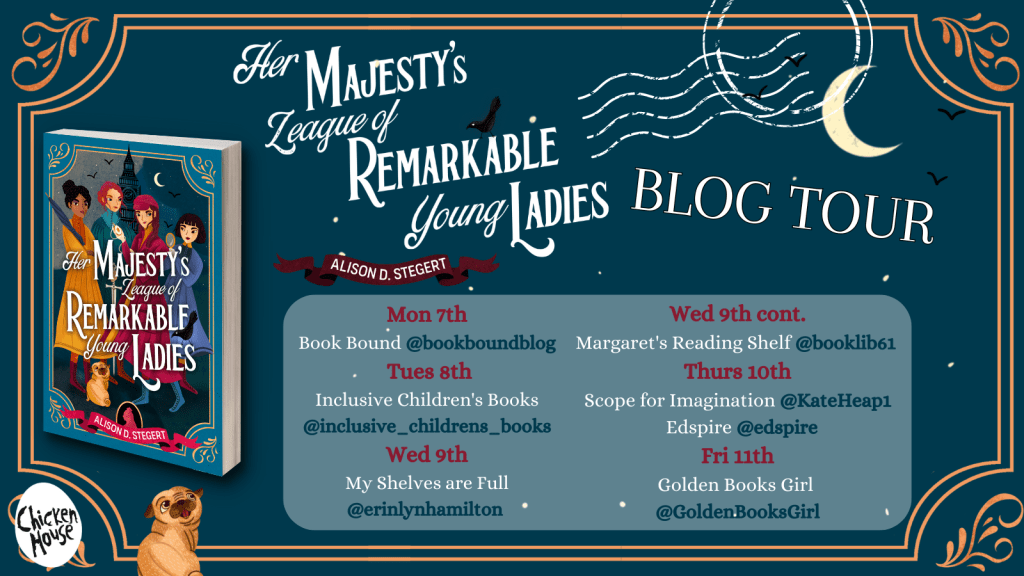
Join the rest of the blog tour:
Follow these links to find out more or purchase on-line:
Bookshop.org:
Amazon:


Books by Kate Heap:


 Scope for Imagination
Thank you, Kate, for this review and the guest spot on your blog.
Alison
LikeLiked by 1 person
Thank you for such a brilliant book! I was so happy for you when I saw you’d won the Chicken House STEM award! Congratulations! My daughter is looking forward to reading this soon. It’s just her kind of book!
LikeLiked by 1 person
Thank you so much. I hope your daughter enjoys it too! I’d like to reblog this post if that’s okay, Kate.
LikeLiked by 1 person
Of course, that’s fine. Best of luck with the rest of the launch.
LikeLiked by 1 person