


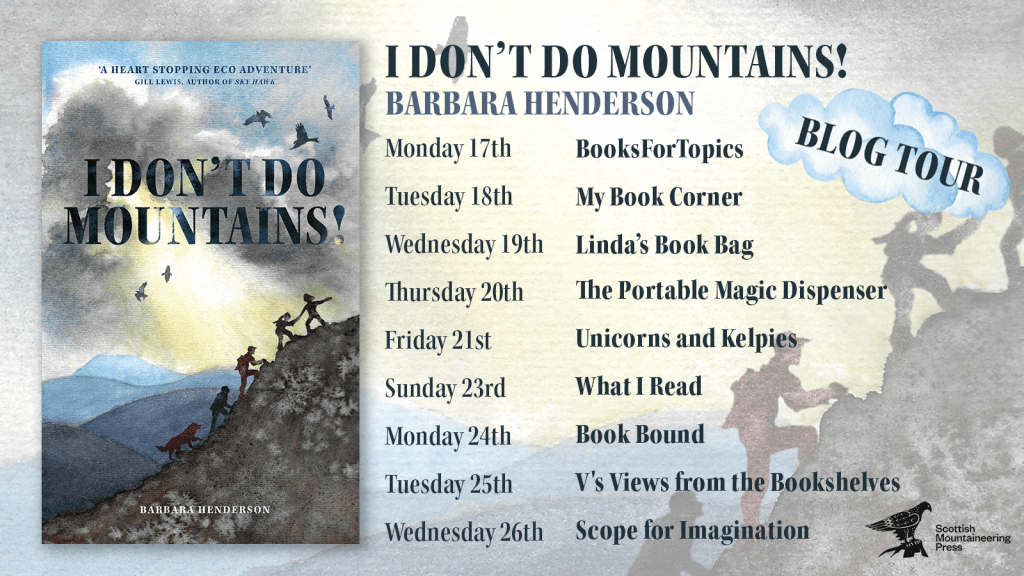
I’m thrilled to welcome author Barabara Henderson to Scope for Imagination with a Q&A about her thrilling new outdoor adventure, I Don’t Do Mountains!
About the story:
Adventures are good things for people in books. But I am not a person in a book. I am Kenzie. I like to READ about adventures, not actually have them. A hillwalking expedition? With a group of strangers AND Sorley Mackay, the most annoying boy in the universe?
Bookworm Kenzie can’t believe her bad luck when her teacher announces plans for a three-day hillwalking expedition into the Cairngorms. She tries everything to get out of the trip, but soon the group heads to the hills with mountain leader Bairdy and set up camp for the night.
Bairdy’s stories of ancient magic fill Kenzie’s mind, but in the cold light of morning, they discover that the mountain leader has vanished, his tent left untouched. They are alone.
I Don’t Do Mountains is an adventure story first and foremost, but in Barbara’s vivid first-person narrative, readers can travel to the windy peaks of Scotland’s wilderness, and survive, even thrive, like Kenzie and her friends.

Your main character, Kenzie, loves to read about adventures but not actually have them herself. How do you hope this story will encourage your readers?
Books are bridges to all sorts of real and imagined worlds, aren’t they? My hope is that the adventure in the story will pull them in, but that the book will for one of those bridges, perhaps making nature’s wild places less threatening, more exciting. By reading about this environment, maybe young people may say to themselves: ‘I know a bit about the mountains now, I’ve read all about it. In fact, I’m now curious to see it all for myself. These characters did hard things and reaped the rewards. Maybe I can do hard things and come out at the other end too?’ Wouldn’t that be amazing?
A three-day walking expedition in the Cairngorms is a challenge! Do you enjoy getting out in the wild? What are your top tips for readers who want to start exploring?
I have some truly hardcore outdoorsy friends, but to be honest, I am a little more mainstream myself, heading to the hills for a day or perhaps tackling a long-distance walking route. But that is kind of the point! I wanted to show that the hills are for everyone, and that there is a walk or an activity to suit us all. I am a storyteller first, a nature lover second. This book combines the two. I would say check out the local walking routes and begin small. And why not watch out for birds, mammals, plants and trees you’ve not seen before, perhaps keeping a nature diary for a limited amount of time – our family really enjoyed that. But if things get on top of you, head out and look up. You’ll feel better – being out there puts everything in perspective.
Friendship and transition are key themes in this story. Why is it such an important book for children moving to secondary school?
I am a teacher, and I work in a primary school, so I can see first hand what a mountain transition can be in the minds of young people. Most cope just fine, with a few minor stumbles, but others can feel paralysed by the sheer drops all around them. Making connections can be scary, but ultimately, connection is what gets us through the wildernesses of our own minds. I loved exploring the dynamics between these very different young people who discover that not only do they have a common challenge – they discover that they have common interests too. I would love to think that schools may read I Don’t Do Mountains to keep pupils company on the on the transition journey.
The children’s mountain leader, Bairdy, loves to tell stories of ancient magic. What are your favourite Scottish legends?
The very landscape is saturated in magic, with many place names echoing the Gaelic for the supernatural. The Gaelic word sìth or sìdh (pronounced shee) translates as ‘fairy’ and ‘hill’ and in Scottish place names is usually considered to denote a ‘fairy hill’. The idea that the hillsides may just open up and reveal a hidden supernatural realm has always fascinated me. The local fairy hill in my own hometown of Inverness gave rise to such a story:
Allegedly, an old man approached two fiddlers and offered them gold to play their jigs at a fairy feast in the fairy lair of Tomnahurich Hill. The musicians agreed and played at the lively fairy feast, with time flying by. However, on their return home, they were shocked to discover that a whole century had passed and everything they knew was gone.
The importance of conservation and the protection of wildlife is a key thread running through this story. What research did you do to learn about dangers to raptors and other threats to the mountains?
While I obviously do a lot of reading around the relevant subjects, my go-to is to ask an expert. I spoke to Alan Hepburn of the rewilding charity Scotland: The Big Picture, and I also drew heavily on the expertise of Ruth Tingay at Raptor Persecution UK who is a fount of knowledge on all things raptor persecution. Websites like the Cairngorms National Park’s and RSPB Scotland were also invaluable. I am lucky that I also had access to fantastic books published by my publisher Scottish Mountaineering Press: Hostile Habitats, for example, which my character Kenzie actually reads in the early chapters.
I Don’t Do Mountains was created through a collaboration with Scottish Mountaineering Press. How did this come about?
Haha, in quite an unconventional way! I bumped into Rob Lovell of Scottish Mountaineering Press at a networking event for international publishing deals. We were both there, but neither of us got any interest from the international representatives. We didn’t really speak to each other at all, but he picked up my book Wilderness Wars after I did a reading. Weeks later, he got in touch to suggest we may possibly collaborate on a non-fiction book for children. I respectfully declared that I was an adventure story kind of girl. He asked: ‘Like what kind of adventure story?’ I had an idea, so I pinged him the first chapter of I Don’t Do Mountains – and the rest is history! 😊
This is such an exciting eco-adventure! Do you have any plans to write more books like this?
For now, I have returned to historical adventure – I have just handed in another manuscript set during the Middle Ages, which will be out later in the year. But I really enjoyed writing this book, so I’m sure it won’t be long before I heed the story-call of the wild again!
Thank you to Barbara Henderson for such fascinating insight into I Don’t Do Mountains – available now! Be sure to follow the rest of the blog tour!
Check out my reviews of some of Barbara’s other books:
Click on the covers below to find out more or purchase online:
Amazon:
Books by Kate Heap:
Click on the image to purchase from Bookshop.org:

Purchase from Amazon:





Disclosure: If you buy books using the links above, I may earn a commission from Bookshop.org whose fees support independent bookshops. As an Amazon Associate, Scope for Imagination earns from qualifying purchases.
 Scope for Imagination