


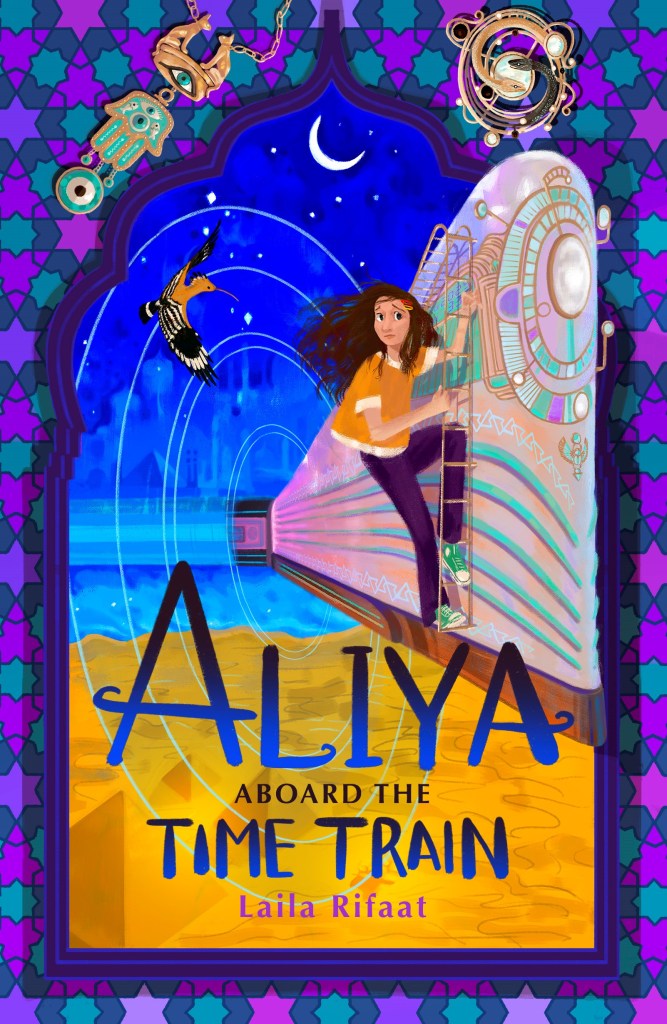
What could be better than a perilous journey on a luxurious, time-travelling train? Aliya has never been so excited – it’s the trip of a lifetime. But when a passenger is murdered, her adventure takes a dangerous turn!
Aliya Aboard the Time Train Blog Tour
Welcome to the fifth stop on the time travelling Silver Express on an exhilarating journey through Egyptian history and culture with Laila Rifaat, author of the Aliya series. Each stop shares a fascinating letter from Aliya to her grandfather describing her experiences in Egypt.
Letter 5: Live like an Egyptian (Housing in medieval Cairo)
Dear Geddo,
I wish I could tell you that the sphinx professor’s death had been resolved, and the killer caught, but nothing could be further from the truth. The atmosphere on the train is so tense now, you could cut it with a knife. It’s unnerving, the way we all look at each other sideways, wondering who the murderer could be. It was a relief to escape the train for another visit to medieval Cairo, even if it only lasted a few hours.
This morning our excursion took us to the mansion of a Mamluk bey, to learn about how well-to-do people lived in the past. Imagine my surprise when the portal opened to a dark, narrow alley, and Soliman pointed out the portal – a plain wooden door. Was this the entrance to the grand mansion? Soliman explained that house-owners from this time kept their entrances plain to avoid showing off. That’s because it was considered bad manners to flaunt your wealth, and because the envy of others could attract the ‘evil eye.’
Once through the front gate, we entered a crooked walkway that took us into the house. Medieval entryways were often crooked so that no one in the street would be able to peek into the house from outside. These guys were really serious about their privacy! Inside the walkway opened to a beautiful, roofless courtyard. At the centre was a trickling fountain surrounded by greenery, palm trees and fig-bushes. There was even a waterwheel pulled by a buffalo! Standing next to the fountain, we were surrounded by stone buildings that rose to about the height of a three-story building. The first story had a terrace of sorts, framed by beautiful stone arches in red and white stripes of stone. The many windows of the upper stories were all covered by intricate wooden mashrabeyyas.
The owner, a wealthy spice merchant, offered us tea and sticky cakes, which we had sitting in the adjacent reception area, a Qa’a, which is usually only for male guests. But, seeing that the merchant was a time-traveller like us, he stretched the rules a little.
After tea we climbed a flight of narrow stone stairs to the upper rooms to the haramlik, the part reserved for women and children. The main room had a huge window like a mosaic of coloured glass and wood which, as the light streamed in, glittered like so many jewels. Other windows, facing the courtyard and the street, were covered with mashrabeyya screens so that the ladies could look out without being seen. More privacy!
The floor under the window was lined with rich, red cushions and low, round tray tables on wooden legs. The walls were lined with beautifully carved wooden cupboards for storage. Above them tiles with floral patterns in white and blue decorated the walls. Large lanterns hung suspended from the ceiling. Just under the roof where shafts for air to pass through – medieval air conditioning!
Next, Soliman took us to a place where people who couldn’t afford mansions lived, a so called rab’. I was surprised to find that they somewhat resembled the multistorey houses we have in our modern world. One was fourteen stories high, something I had never expected to see this far back in history! We visited one man living in a seven-story house who had a garden on the roof where he was raising a calf. He even had a waterwheel up there, and several fruit-trees, like orange and banana. These houses could fit as many as 350 people, each in a unit of about 15 square meters, which is about as big as one of our rooms back in modern Cairo. This part of town was so dense, and its streets so narrow that no light reached down to street-level and, even though it was morning, it felt like night all of a sudden. The bazaars and side-streets had lamps lit to see what they were doing. Victoria and I even spotted some bats flying overhead.
Next, we visited a wekala, a caravanserai in the middle of the city, a hub for merchants and their wares. The wekala had a trading centre at ground level, and cheap housing above with stories that were built around a rectangular courtyard. Even though this was supposed to be a budget place to live, it looked fancy to me. Striped stone arches ran the length of the first-floor terrace, and all windows had beautiful wooden mashrabeyyas. This inner courtyard, though crowded, also had a fountain decorated in a black, red, and white pattern. You have to hand it to them. The medievals really knew how to build houses!
I’m off to wash the medieval street dust off before dinner, but I’ll write tomorrow and tell you all about our visit to a hospital!
Your granddaughter,
Aliya
Useful links
- Medieval Housing: https://www.medievalists.net/2021/12/medieval-apartment-buildings/
- https://www.bibalex.org/en/center/details/sinnarihouse/
- https://islamicart.museumwnf.org/database_item.php?id=monument;ISL;eg;Mon01;17;en&pageT=N
- https://www.touregypt.net/featurestories/ghouri.htm
About Laila Rifaat

Laila moved to Cairo, Egypt, in her twenties to explore her father’s native country. She fell in love with the country and has lived in Cairo for over 30 years now. It remains a main source of inspiration for her stories. She has an MA in English and Comparative Literature and has worked as an ESL and IGCSE teacher. Nowadays she’s a full-time writer and stay-at-home mum to her four kids. Find out more at www.lailarifaat.com
Aliya Aboard the Time Train
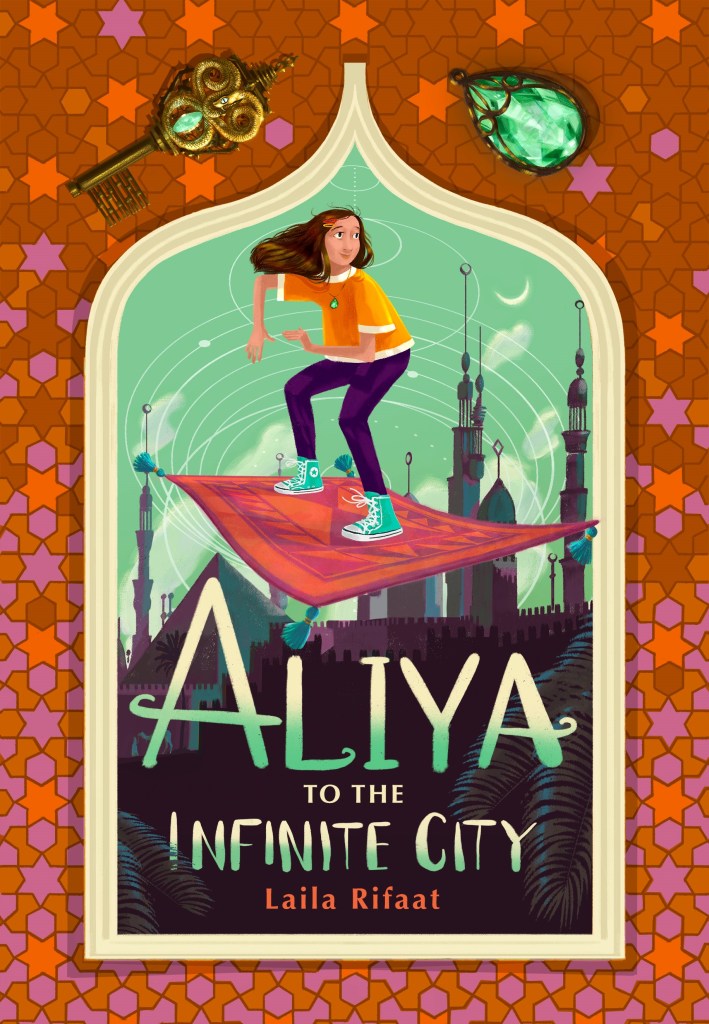
Aliya Aboard the Time Train is the spectacular sequel to Middle Eastern-inspired fantasy Aliya to the Infinite City.
When sinister magic threatens Aliya’s world once more, she is sent away on a school trip for her own safety aboard the time-travelling Silver Express. But what is supposed to be an educational journey through Egyptian history becomes a deadly race to save it from evil time-twister and master of disguise, Dorian Darke. Find out more at www.lailarifaat.com
Thank you to Chicken House for inviting me to take part in this fascinating blog tour! Don’t miss the other stops:
Books by Kate Heap (ad):
Order Fiction & Poetry and Non-fiction for Year Two on the links below:
Books for Years 3 -6:


 Scope for Imagination