
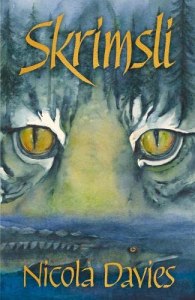
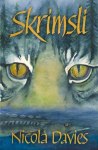
Skrimsli is the incredible prequel to the environmental fantasy The Song that Sings Us by Nicola Davies. Travel back in time to discover the story of the great tiger sea captain who began life unwanted and afraid in a tyrannical circus. Through the kindness of his friends, Owl and Kal, Skrimsli’s great strength, sharp senses and deep intelligence grow. This is a story of connections – with the world and with each other.
You can find out more about The Song that Sings Us in my original reviewand in my interview with Nicola Davies for the paperback edition blog tour. Skrimsli is available now for age 12+.
I’m honoured to welcome Nicola Davies to Scope for Imagination with a fascinating guest post about how she discovers the very unique names of her characters.
Naming Names ~ A Guest Post by Nicola Davies
Naming characters is tricky, and important. I spend ages and ages deciding on names. I do a lot of research of all different sorts to name my characters.
If I’m writing something set in the real world that gives me a start. If it’s a story set in my own time and culture I just have to pick names with associations that fit the character. Of course, everyone’s name associations are different. If your first, lovely boyfriend was called Pete (ah, Pete!) then that name will have different associations from the person whose mean spirited great uncle was a Pete. How I feel about a name is the first most important thing, because I need to feel a connection with my character every time I type their name. But wider connections are important too. The parents who name their child Gertrude in this day age are very different from the parents who name their child Beyonce. So Gertrude and Beyonce are going to be very different kids with very different backgrounds. I have to think about each character’s family context and choose names appropriately.
Nicknames are different and are acquired by a different route. You earn or choose a nickname but it says a lot about how others see you or how you see yourself. In Guardians of the Galaxy, Peter Quill is forever trying to acquire the nickname Star Lord, mostly to the great hilarity of those around him. The fact that he chooses that nickname and that no one uses it, tells us a great deal about him.
Finding a name for characters whose story is set in a real place I’m not familiar with leads me down all sorts of culturally and historically interesting roads. Rubbish Town Hero was set in West Africa – I didn’t specify the country in the text but in my head I knew it was Nigeria. I named the main character Chipo after reading how the name means ‘a gift’. It’s mostly a girl’s name in Africa but sometimes it can be a boy’s name too and I liked the slight gender ambiguity which I suspected would make my Chipo try even harder to be the tough guy he thinks he is. In finding names for the characters in The Lion Who Stole My Arm, set in Mozambique, I found that Mozambique’s Portuguese colonial history influences the naming of children so the lead character is Pedru. I gave the children in The Elephant Road the names of people I’d met on my research trip to its setting in the forests of North East India.
Of course naming characters in fantasy novels is a whole different thing. I never want to give them names that anyone would know as a name in our world. So in my first YA novel, Home, I had a copy of the Screwfix catalogue on my desk so I could use the names of odd tools and bits of carpentry kit to name the goodies. For the baddies – who I wanted to have a kind of Mafioso vibe – I chose various Italian adjectives.
The very best names just arrive with the character as they emerge, like a developing photographic print, in your mind. Almost the very first things I knew about Harlon, Ash, and Xeno in The Song that Sings Us, were their names. Their mother Toren went through various different name changes, but that seemed pretty appropriate for someone whose nickname as an eco-activist was ‘the ghost’.
One of the ways I name characters is playing with Google Translate. I put an attribute of a character – brave, strong, gentle, noble, cruel, fearful – into the English box and then see what it looks like in other languages. I might choose something that has a linguistic or cultural echo that’s appropriate to the invented context of the fantasy, or I might choose something that just sounds good. For example in Skrimsli the desert princess has an eagle whose name is derived from the Arabic word for speed; Sayka sounded good and as a word with Arabic connections had the right desert feel. Skrimsli’s name comes from Finnish because I wanted him to have a cold, snowy feel to his name not a hot jungle-y one, because he is a tiger of cool green forests that are buried in snow in Winter.
Sometimes, of course, naming is much simpler. For the place names in The Song that Sings Us, I just spelled a few things backwards – like Cymru and Cardiff – a deliberate parallel between the real world and the one I invented. And sometimes the journey I go on to find a name is so long, so convoluted that when I arrive I’ve completely lost how I got there. The wise elephant in The Song That Sings us is called Enkalamba – I love the name and it’s perfect for her but the route I took to get there, though West African languages, stories and existing names for human children, is utterly lost to me now. As is the playing around with Russian words and surnames and goodness know what else that finally gave me the name for the cruel ringmaster in Skrimsli, Kobret Majak.
Usually there is one character in a book whose name gets changed at the last minute, for no other reason than it just didn’t sound so good read aloud. The character Kal in Skrimsli, whose gender I myself never knew, was, all the way through the writing process, Elo. But Elo was too soft read aloud and, as I didn’t want to reveal Elo’s gender even to myself, too feminine. So right at the very end Elo became Kal, by ‘find and change all’. It’s always a very weird moment to see a character who has been one thing in your heart all the way through become, in a small strange way a stranger. But I always think of this process, when it is necessary, as a useful ritual of separation, giving my characters and their story freedom from me, so they can form new relationships with the people whose names I don’t know at all but who matter most – readers.
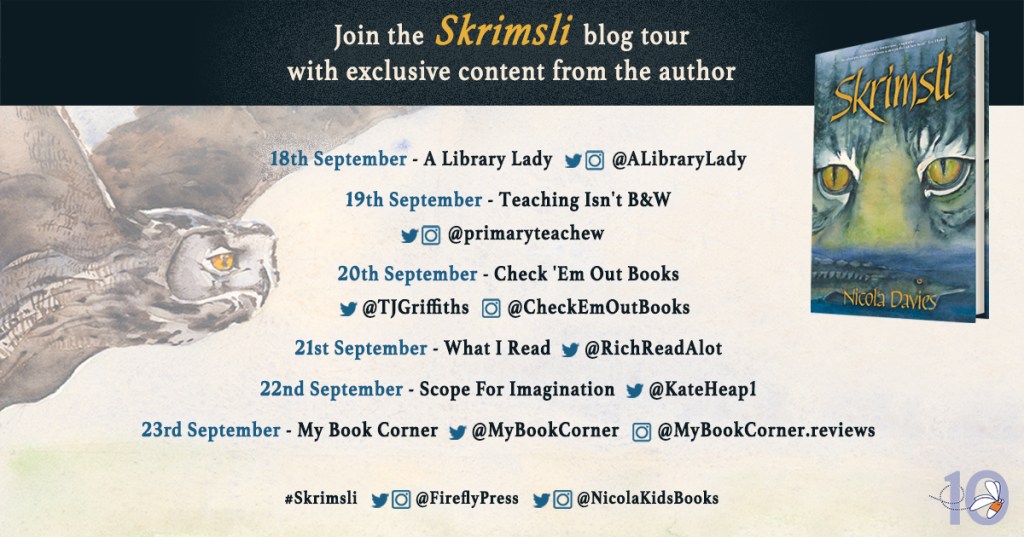
Thank you to Firefly Press for a copy of this stunning book! Be sure to seek out the other posts on the tour.
Follow these links to find out more or purchase on-line:
Bookshop.org:
Amazon:


Books by Kate Heap:


 Scope for Imagination