



Kelly Yang’s stories are honest and so engaging. They pull readers right into the characters’ lives with all the emotions, heartbreaks and triumphs.
I’m so excited to share an extract from chapter two of Finally Seen. Lina has just arrived at the airport in Los Angeles hoping to live the American Dream.
I scamper after my escort, who kindly helps me with my carry-on suitcase. She’s a fast-walking Chinese lady named Miss Chen, with a walkietalkie and a giant stack of documents, leading me through immigration. The immigration officer takes one look at my passport and stamps it with his big rubber stamp.
As we wait for my bags, Miss Chen chats with me in Mandarin.
“You excited? I hope your parents are here already, we got in an hour early.”
“I’m sure they’ll be here!” I say to her, rising to my tippy toes with excitement. I can hardly wait to walk out those double doors to see them.
I scan the conveyer belt for my luggage. Lao Lao made me bring over three full suitcases of stuff. One of them is an entire suitcase of sweaters she knitted for me and Millie – even though Mum kept telling her it’s warm in LA.
“Did you go on a trip to visit your relatives?” Miss Chen asks.
I open my mouth to say No, this IS the trip – but I nod instead. Probably easier.
“You have any brothers or sisters?” she asks.
“I have one sister,” I tell her. “She’s seven.”
“Oh, that must be fun! You two love playing together?”
I cross my fingers behind my back. Sure hope so!
As I wait, I tell Miss Chen all the things I know about my family by heart, from reading their many letters. I tell her my dad is a scientist. A microbiologist, to be exact. My mother works at a big fancy salon. We live in a beautiful pale blue two-story house with a white fence in Los Ramos, California. A house that’s taken my parents some time to finally find. It’s just forty miles from Los Angeles.
I talk of my family’s accomplishments, as if they’re mine.
“Wow,” she says. “Sounds like they’ve really achieved the American dream.” I smile.
Every movie and TV show I watch is always talking about the American dream. I’m still not sure exactly what it means, but I think it means something like this:
1. To be able to buy any kind of Frappuccino you want.
2. To have a nice home and fill your bed with a lot of pillows, like you have a thousand heads.
3. To say I love you, all the time, to your family. And not be embarrassed.
I like number three the most. I don’t remember when Mum and I stopped saying it on the phone. Maybe Mum didn’t want my little sister Millie to be jealous. Or she didn’t think I needed to hear it.
But I did.
The truth is, my time in the waiting city wasn’t just all dumplings and tea. It was hard, too. I’m not going to tell Mum now that I’m back because what’s the point? But I hope I hear Mum say I love you again. All the time. And not just because it’s the American thing to say.
From the publisher:
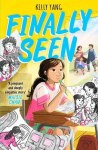
A gripping middle-grade novel about Lina, who leaves China to be reunited with her parents and little sister in the US. After five years in Beijing living with her grandma and being teased at school as the “girl left behind”, this is the moment that Lina has been dreaming of, but once she’s there she realises it isn’t quite like the postcards her parents have been sending her.
They live in an apartment, not a house as the postcards had described, and school is much more difficult than she thought it would be, to the point where she’s scared of making a mistake or mispronouncing words. Lina decides it’s best for her to stay silent and avoid the humiliation. When her teacher’s book selection is pulled into question, Lina has to get over her fear of speaking up and use her voice to choose a future where she is finally seen.
About family, friendship and the power of belonging, Finally Seen is an inspiring story of courage and resilience based on Kelly Yang’s own experiences of moving to America at aged 6 and feeling scared and left out.
Be sure to visit the rest of the posts on the blog tour:

Follow these links to find out more or purchase on-line:
Bookshop.org:
Amazon:


Books by Kate Heap:


 Scope for Imagination